
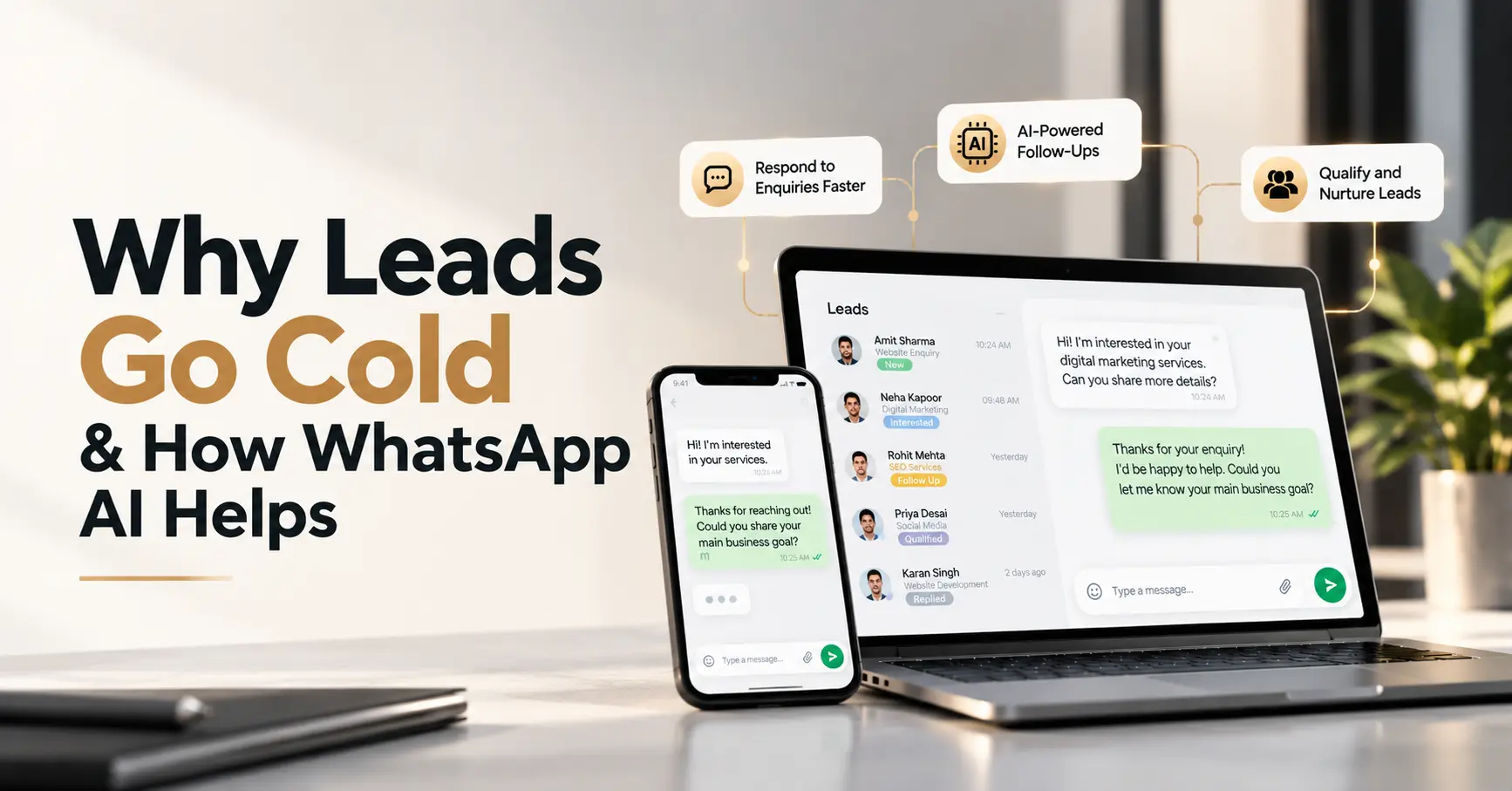
Learn why leads stop responding and how WhatsApp AI can support timely replies, relevant follow-ups and better lead management for your business.
Quick Answer
Leads often go cold because businesses respond too late, send generic follow-up messages, fail to address customer questions or lose track of enquiries. WhatsApp AI can help businesses manage lead follow-ups more consistently by acknowledging enquiries, answering common questions, asking relevant qualification questions and reminding prospects about the next step.
Why Do Leads Go Cold?
Generating enquiries is only one part of the sales process. A potential customer might fill out a website form, click an advertisement, send a WhatsApp message or ask about a service on social media. But an enquiry does not automatically mean the person is ready to buy.
Sometimes, the customer is comparing options. In other cases, they need more information, are waiting for the right time or simply have not received a useful response.
Here are some common reasons leads stop responding.
1. Slow Responses and Missed Enquiries
When someone contacts a business, they may also be contacting its competitors. If a response takes too long, the prospect might move on or lose interest.
This can happen when sales teams are busy, enquiries arrive outside business hours or messages get buried in multiple communication channels.
Businesses can reduce missed opportunities by:
- Acknowledging new enquiries promptly.
- Keeping enquiry details organised in a shared system.
- Notifying the relevant team member when a lead needs attention.
- Providing a clear next step instead of leaving the conversation open-ended.
2. Generic Messages and Unanswered Questions
Customers are less likely to engage with messages that feel automated in the wrong way. Repeatedly sending “Are you interested?” does not help someone who is waiting for pricing, service details or an explanation of how the process works.
Follow-ups should reflect the conversation so far. A person who asked about pricing needs a different response from someone who wants to understand the service before making a decision.
3. Poor Follow-Up and Lead Qualification
Some prospects need more than one conversation before they are ready to proceed. Without a clear follow-up process, businesses may forget to reconnect with interested enquiries.
Poor qualification can also create problems. A sales team might spend time contacting people who are not looking for the service, while genuinely interested prospects receive little attention.
A structured process helps businesses understand what each lead needs and decide what should happen next.
What Is WhatsApp AI Lead Follow-Up?
WhatsApp AI lead follow-up uses artificial intelligence and automation to help businesses respond to enquiries, manage conversations and organise follow-up activities through WhatsApp.
Depending on the tools and integrations being used, a system may be able to:
- Send an acknowledgement when a new enquiry arrives.
- Answer frequently asked questions using approved business information.
- Ask relevant questions to understand a prospect's requirements.
- Share suitable service information or direct prospects to a booking page.
- Schedule eligible follow-ups according to the configured workflow.
- Route complex questions or high-intent enquiries to a human team member.
It is important to distinguish a basic automated message from an AI-assisted conversation. A simple automation follows predefined rules, while an AI-enabled system may interpret questions and generate responses within its configured capabilities.
The actual features available depend on the platform, integrations, account setup and applicable WhatsApp policies.
How WhatsApp AI Can Help Re-Engage Leads
1. Responding to New Enquiries Promptly
A timely acknowledgement lets prospects know their message has been received. For example, a service business could confirm that an enquiry has arrived and ask what type of assistance the person needs.
This does not replace a meaningful response from the business. It helps prevent an enquiry from being overlooked while the appropriate team member prepares to assist.
2. Qualifying Leads Through Relevant Questions
Not every enquiry requires the same sales process. WhatsApp AI can ask a small number of relevant questions to understand the customer's needs before passing the conversation to the team.
For example, a digital marketing business might ask:
- Which service are you interested in?
- What is your main business goal?
- Do you already have a website?
- When would you like to get started?
These questions should be relevant to the service and should not make the conversation feel like a lengthy application form.
3. Sending Contextual Follow-Ups
A useful follow-up gives the prospect a reason to continue the conversation. Instead of repeating the same reminder, businesses can provide information connected to the person's original enquiry.
For example, if a prospect requested information about website development, a suitable follow-up might ask whether they need a new website or improvements to an existing one.
Follow-ups should be limited, relevant and consistent with the person's communication preferences and applicable messaging rules. If someone declines further contact, that request should be respected.
4. Recognising When a Human Should Take Over
AI is not the right solution for every conversation. Some prospects have detailed questions, specific objections or requirements that need professional judgement.
A well-designed workflow should transfer the conversation to a human when:
- The customer asks for a detailed quotation or negotiation.
- The question falls outside the system's approved knowledge.
- The prospect expresses frustration or confusion.
- The enquiry requires a customised recommendation.
- The customer explicitly requests to speak with a person.
The goal is to support the sales team, not to remove human interaction from the customer journey.
Manual Follow-Up vs AI-Assisted WhatsApp Follow-Up
| Activity | Manual follow-up | AI-assisted WhatsApp follow-up |
|---|---|---|
| First response | Staff respond when available | An automated acknowledgement can respond promptly |
| Lead qualification | Staff ask questions individually | AI can ask predefined, relevant questions |
| Follow-up reminders | Staff track pending enquiries | Automation can flag or schedule eligible follow-ups |
| Personalisation | Depends on the information staff use | Responses can use available conversation context |
| Complex queries | Staff handle the conversation directly | The system should escalate when human support is needed |
| Oversight | Staff review and manage conversations | Human monitoring remains necessary |
These capabilities depend on the tools and integrations a business uses. Not every WhatsApp setup includes AI conversations, automated scheduling or CRM integration.
A Practical WhatsApp AI Follow-Up Workflow
Businesses do not need to automate every stage of the sales process. A simple, well-planned workflow can be a sensible starting point.
Step 1: Capture and Acknowledge the Enquiry
Record the enquiry source, contact details and the service the person is interested in. Send an appropriate acknowledgement when the setup permits it.
Step 2: Understand the Lead's Requirements
Ask a few relevant questions and provide accurate information. Avoid asking for details that are unnecessary to the enquiry.
Step 3: Decide the Next Action
Based on the conversation, the next step might be to share service details, arrange a consultation, send a quotation or connect the prospect with a team member.
Step 4: Follow Up Appropriately
If a response is still pending, use a relevant follow-up only when permitted. Avoid sending repeated messages simply because the automation allows it.
Step 5: Review and Improve the Process
Monitor useful indicators such as response time, follow-up completion, qualified enquiries, booked consultations and lead-to-customer conversion. Review these metrics over time rather than assuming that automation alone caused an improvement.
Common Mistakes to Avoid With WhatsApp Automation
WhatsApp AI can make follow-up easier, but poor implementation can damage the customer experience.
Avoid these common mistakes:
- Sending repetitive messages: Repeating the same message can frustrate prospects rather than encourage a reply.
- Using inaccurate information: AI responses should be grounded in approved service details, prices and business policies.
- Automating every conversation: Complex enquiries and customer concerns may require a person.
- Ignoring consent and messaging rules: Use appropriate permission-based communication, respect opt-outs and follow applicable WhatsApp policies.
- Measuring only message volume: More messages do not necessarily mean more qualified leads or sales.
- Failing to review conversations: Regular checks help identify incorrect responses, missed handoffs and opportunities to improve the workflow.
Is WhatsApp AI Right for Every Business?
WhatsApp AI may be useful for businesses that receive regular enquiries and need a more consistent way to respond and follow up. Examples include service providers, education businesses, real estate teams and businesses that generate leads through digital advertising.
It may be less useful when enquiry volume is very low, every conversation requires extensive personal attention or the business has not yet established a clear sales process.
Before implementing it, consider:
- How many enquiries the business receives.
- Which questions customers ask most often.
- Where leads are currently getting missed.
- Whether the existing tools support the required integrations.
- Who will review conversations and handle escalations.
- How the business will measure meaningful outcomes.
Start with one clear problem, such as missed enquiries or inconsistent follow-ups. Test the workflow, review the conversations and expand only when it is working reliably.
Final Thoughts: Making Lead Follow-Up More Consistent
Leads going cold is not always a sign that a marketing campaign has failed. Sometimes, the gap appears after the enquiry arrives: a delayed response, an unanswered question or an inconsistent follow-up process.
WhatsApp AI can help businesses manage these gaps through timely acknowledgements, relevant conversations and structured follow-ups. Its value depends on how well the workflow is designed, how accurately the system responds and when the team steps in.
At GDS Media, the focus is on helping businesses strengthen their digital presence and make better use of their marketing efforts. Businesses exploring ways to improve their enquiry management can learn more about our digital marketing services and consider how a clearer lead follow-up process could fit into their broader marketing strategy.
Frequently Asked Questions
1. Why Do Leads Stop Replying on WhatsApp?
Leads may stop replying because they are comparing options, are not ready to buy, have unanswered questions or have lost interest. Slow responses and irrelevant follow-ups can also contribute. The reason varies from one prospect to another.
2. Can AI Automatically Follow Up With Leads on WhatsApp?
Yes, certain WhatsApp Business Platform integrations and AI-enabled tools can support automated follow-ups. The available features depend on the setup, messaging permissions, templates where required and applicable platform policies.
3. How Can Businesses Re-Engage Cold Leads?
Start by reviewing the prospect's original enquiry. Send a relevant, helpful message when permitted, address any unanswered questions and offer a clear next step. If the person does not want further contact, respect that preference.
4. Can WhatsApp AI Qualify Leads Before a Sales Call?
Yes. When configured appropriately, AI can ask relevant questions about a prospect's requirements, goals or timeline. A sales team member should review the information and handle enquiries that require detailed judgement.
5. Does WhatsApp AI Guarantee More Conversions?
No. WhatsApp AI can help organise responses and follow-ups, but conversions also depend on lead quality, pricing, service fit, customer trust and the sales process. Businesses should evaluate actual results rather than rely on guaranteed claims.
Have questions about implementing AI marketing in your business? Book a free strategy call with our team.